
How to Calculate (and Fix) Your Burn Multiple
Last updated June 8, 2026
Your burn multiple is the cleanest read on capital efficiency. The formula, the 2026 benchmarks, and the four levers that actually move it.
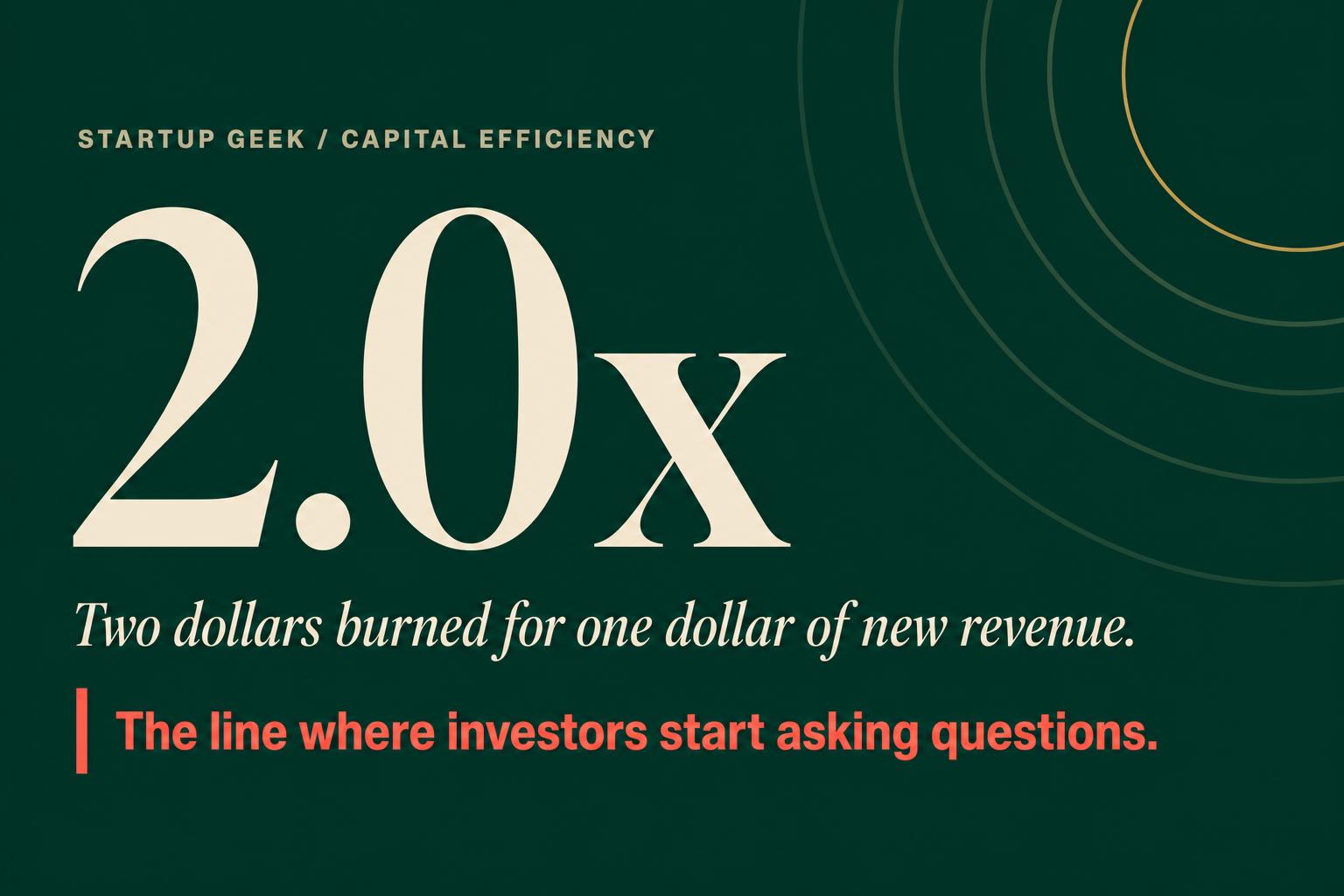
TL;DR: Your burn multiple is net burn divided by net new ARR. It measures how many dollars you spend to buy one dollar of recurring revenue, which makes it the cleanest single read on capital efficiency. Under 1.0 is exceptional, 1.0 to 1.5 is strong, 1.5 to 2.0 is worth watching, and above 2.0 invites hard questions from investors. It is a better signal than your growth rate alone, and most of the levers that improve it are within your control this quarter.
What is a burn multiple?
A burn multiple is a capital efficiency metric: net burn divided by net new ARR over the same period. It answers one question in a single number. How many dollars are you burning to add one dollar of annual recurring revenue?
The metric was popularized by David Sacks of Craft Ventures, and investors lean on it because almost any serious problem in a startup eventually shows up here. A gross margin problem, a customer acquisition problem, or weak product-market fit all inflate the burn multiple. One number, most of the story.
Burn rate vs burn multiple
These two get confused, so it is worth separating them. Your burn rate is how much cash you spend per month, full stop. Your burn multiple measures the efficiency of that spend: how much you burn relative to the new revenue you create. A high burn rate is not automatically a problem if the burn multiple is low, because it means the spending is producing revenue. A high burn multiple is the warning sign.
Why your growth rate alone can lie to you
Two founders walk into a board meeting. Both grew ARR by $1 million last quarter. On the slide, they look identical.
One burned $1.2 million to get there. The other burned $3 million.
Same number on the chart. Completely different companies underneath. The first is being pulled by the market. The second is pushing the product uphill, spending heavily to manufacture growth that does not come naturally.
Investors know the difference, and in a selective 2026 funding market they are pricing it. Growth rate tells them you can spend. Your burn multiple tells them whether you can build.
The formula
Burn Multiple = Net Burn / Net New ARR, over the same period.
Net burn is cash out minus cash in from operations for the period. Net new ARR is the change in annual recurring revenue over that period: new plus expansion, minus churn and contraction.
Worked example. You burned $200,000 last quarter and added $100,000 of net new ARR. Your burn multiple is 2.0. You spent two dollars to buy one dollar of recurring revenue. You can run it monthly or quarterly, just keep the numerator and denominator on the same time frame.
What is a good burn multiple? The 2026 benchmarks
Under 1.0 is exceptional. You are converting burn into revenue with rare efficiency.
1.0 to 1.5 is strong. This is where well-run, scaling startups live.
1.5 to 2.0 is reasonable, but watch it closely.
Above 2.0 and you will face real scrutiny.
For context, the median Series A SaaS company in 2026 sits around 1.6, and SaaS companies that reach an IPO have typically run around 1.5 across their life. The bar is not perfection. The bar is knowing your number and keeping it honest.
The four levers that actually move it
Most of what improves your burn multiple is within reach this quarter.
- Cut redundant spend first. Most Series A companies carry 15 to 25 percent of burn in duplicate software, misbilled vendors, and underused services. A structured spend audit commonly recovers $50,000 to $200,000 a year, with no growth required.
- Fix customer acquisition efficiency. If each customer costs too much to win, burn climbs without matching revenue. Look at your CAC payback period before you pour more into the top of the funnel.
- Improve gross margin. If delivering your product costs too much, burn rises as you scale and the multiple never improves. Margin work compounds.
- Fix productivity before adding headcount. People inflate burn immediately and add revenue only later, if at all.
Do this week
Calculate your burn multiple for the last two quarters. Two numbers, ten minutes. If it is trending up, find out why before your next board meeting, not during it. Then run a spend audit, because the redundant-software line alone often pays for the exercise many times over.
Growth is the number you put on the slide. Your burn multiple is the number that tells the truth.
Frequently asked questions
What is a good burn multiple?
Under 1.0 is exceptional, 1.0 to 1.5 is strong, 1.5 to 2.0 is acceptable but worth monitoring, and above 2.0 tends to draw investor scrutiny. The median Series A SaaS company in 2026 sits near 1.6.
How do you calculate burn multiple?
Divide your net burn by your net new ARR over the same period. If you burned $200,000 and added $100,000 of net new ARR last quarter, your burn multiple is 2.0.
What is the difference between burn rate and burn multiple?
Burn rate is how much cash you spend per month. Burn multiple measures how efficiently that spend produces new revenue. A high burn rate can be fine if the burn multiple is low.
Can you improve your burn multiple without growing faster?
Yes. Cutting redundant spend, improving gross margin, and fixing customer acquisition efficiency all lower the multiple without requiring any additional growth.
Where this fits
Your burn multiple is one of a handful of numbers every founder should be able to recite cold. See the full set of startup financial metrics investors test you on, and if you want to check how well you read your own books, take the free accounting literacy quiz.
Want help
Getting your numbers clean, calculating metrics like this correctly, and walking into a board meeting in control is most of what we do at Startup Geek. Book a free consultation. No pitch.