
The Most Efficient Company in Tech Was Built by 11 People With No Investors. Here's the Catch.
Last updated May 16, 2026
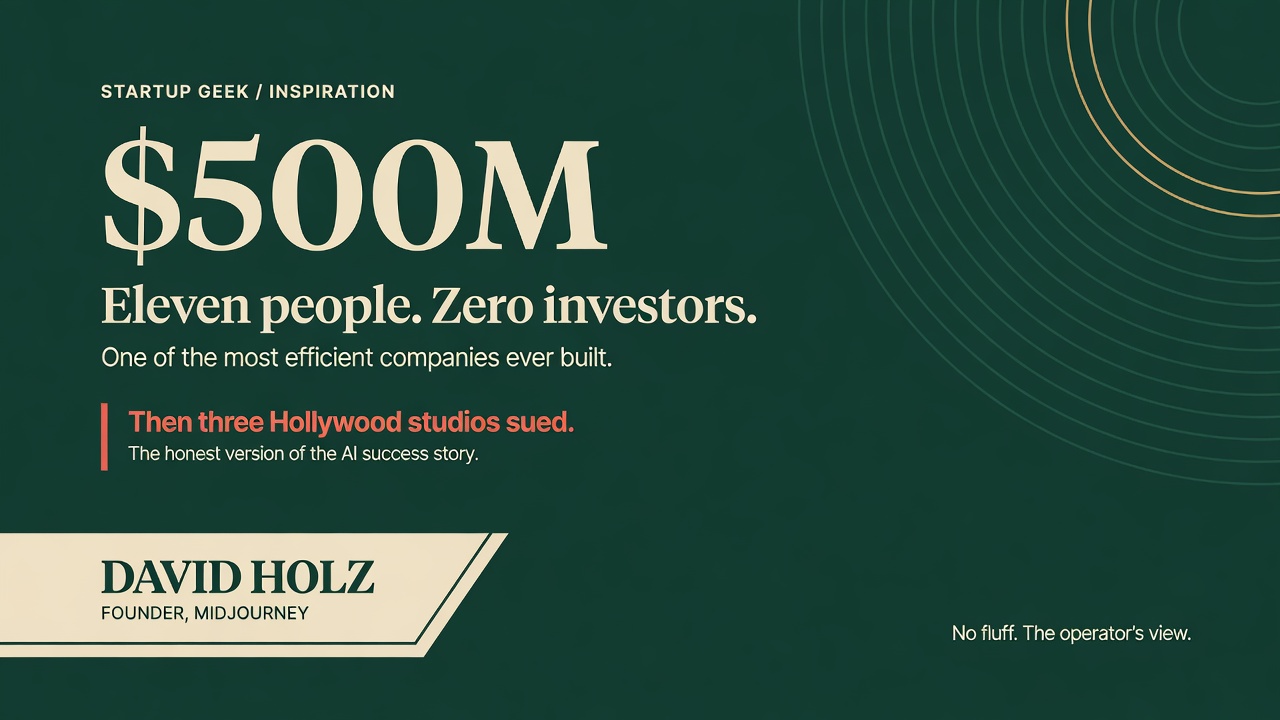
Most founder stories follow the same arc: raise, hire, repeat. David Holz did almost the exact opposite and built one of the most profitable companies in software history. Then Hollywood sued him.
Most founder stories follow a familiar arc. Raise a seed round. Hire fast. Raise a Series A. Hire faster. Chase growth until something works or the money runs out.
David Holz built a company that did almost the exact opposite, and it became one of the most profitable businesses in the history of software. Then three of the five biggest studios in Hollywood sued him.
Both halves of that sentence are true, and both matter. This is the story of Midjourney, told honestly, including the part the headlines skip.
The founder who already knew better
Holz was not a first-timer who got lucky. He studied physics and math, and worked at NASA and the Max Planck Institute before he ever started a company. Around 2011 he co-founded Leap Motion, a hardware startup building gesture-recognition technology, the kind of hand-tracking interface that looked like science fiction at the time.
Leap Motion was the textbook venture-backed company. It raised more than $100 million. It carried a peak valuation north of $300 million. And it taught Holz a lesson that shaped everything he did next: raising large amounts of money slowly turned him from a researcher into a manager, someone who spent his days worrying about quarterly growth instead of building. In 2019, Leap Motion was acquired by Ultrahaptics for roughly $30 million, a fraction of what it had once been worth.
That could have been a closing chapter. Instead it became the blueprint for what he refused to do again.
Eleven people, zero investors
In 2021, Holz started Midjourney as what he called an independent research lab. The founding team was eleven people, and even as it later grew it stayed remarkably lean. One founder. Eight developers. One person for legal. One for finance. No marketing hire. No sales team. No growth department.
He took no venture capital. Not a seed round, not a Series A, nothing. The decision was deliberate and philosophical. Holz had already lived the alternative and decided the price was too high. He did not want a board optimizing him toward investor returns. He wanted to build something people loved and keep control of how it got built.
What makes it remarkable is that it worked almost immediately. Midjourney was profitable within months of its public launch, by August 2022. For context, OpenAI took about a decade to reach profitability, and as of 2026 it still spends far more than it earns. Anthropic is not profitable either. Midjourney did it in months, with eleven people and no outside money.
The distribution hack nobody else saw
Here is the decision that actually built the company, and it had nothing to do with the AI model.
In 2022, every other AI startup was raising millions, hiring engineers, and building a polished website. Holz launched a bot on Discord instead. Users typed /imagine followed by a description, waited a few minutes, and got an image back.
It sounds almost too simple. The mechanic underneath it was not. By default, every image generation happened in a public Discord channel. When you typed a prompt, everyone else in that channel watched your image render in real time. They saw the blurry shapes sharpen into something striking, and they immediately thought "I want to try that." Their result then appeared publicly, and someone else saw it, and the loop never stopped.
Midjourney did not buy ads. It did not run influencer campaigns. It turned every single image its users generated into a live product demo and a free advertisement, all at once, with zero engineering effort beyond the bot itself. Discord brought 175 million existing users and the infrastructure. Midjourney just parasitized it brilliantly.
Then it did one more counterintuitive thing: it killed the free tier. By March 2023, there were no free trials. Every user was a paying user. That is why the company was profitable from month one instead of year three. By May 2025, the Midjourney community had reached 21 million members, the most popular server on all of Discord.
The numbers that break the model
The financial trajectory is the part that makes traditional startup math look broken.
Revenue went from roughly $50 million in 2022, to surpassing $200 million in 2023, to about $300 million in 2024, to roughly $500 million in 2025. Holz confirmed the early figures himself in an interview with The Information.
The metric that stops people cold is revenue per employee. Midjourney generates somewhere around $4.7 million in revenue per head. Google does roughly $1.8 million. Meta about $1.6 million. OpenAI, the poster child of the entire AI boom, does roughly $500,000. One honest caveat: headcount estimates for Midjourney vary widely across sources, from the original eleven to somewhere over a hundred today. The exact number is fuzzy. The order of magnitude is not. Whatever the precise figure, this is one of the leanest revenue engines ever assembled.
By 2025, Meta had partnered with Midjourney to license its aesthetic technology for future products. The company that took no investors had become an infrastructure layer for one of the largest companies on earth.
The part the headlines skip
If the story ended there, it would be pure inspiration. It does not end there, and pretending otherwise would be dishonest.
Midjourney is the defendant in the highest-profile AI copyright litigation in the industry. In June 2025, Disney and Universal filed a joint suit in federal court in California, alleging Midjourney trained its models on copyrighted works without permission and produces infringing outputs of characters they own. In September 2025, Warner Bros. Discovery filed its own suit, calling the infringement "systematic, ongoing, and willful" and seeking up to $150,000 per work. Three of Hollywood''s five biggest studios are now suing the same eleven-person research lab. A separate class action brought by visual artists is set for trial in 2027.
This is genuinely different from the kind of scandal that should disqualify a founder from an inspiration piece. There is no consumer fraud here. The revenue is real and independently corroborated. The customers get what they pay for. What is unresolved is a legitimate and unsettled legal question that the entire AI industry is fighting over right now. Midjourney''s defense is the fair-use argument: that training on billions of public images is a highly transformative process more like human artistic learning than copying. Reasonable people, and reasonable courts, genuinely disagree about where this lands. As of early 2026 the Disney case had been ordered into mediation, with proceedings scheduled through the second half of the year. Nothing is decided.
But the exposure is real, and a founder who described his training data as "a big scrape of the internet" built that exposure into the foundation of the company at the same time he was building the revenue engine. Both were design choices. Both are now playing out at the same time.
What founders should actually take from this
Strip away the headline number and here is what is left, which is the part worth keeping.
You do not need permission, a board, or a war chest to build something enormous. Holz proved a small team with conviction and no investors can outproduce companies a hundred times its size. That is real, and it is more achievable now than it has ever been.
Distribution beats product more often than founders want to admit. Midjourney did not win because its model was the best in every benchmark. It won because Holz found a distribution mechanic, public generation inside an existing 175-million-user network, that turned every customer into a marketer. Most founders obsess over the product and treat distribution as an afterthought. He treated distribution as the product decision.
Profitability is a strategy, not just an outcome. Charging from day one with no free tier was a choice that bought independence. It is the single decision that made saying no to venture capital survivable.
And the hard one: speed and legal exposure are often the same decision wearing two faces. The "scrape the internet and move fast" approach that made Midjourney possible is the same approach that brought three studios to its door. AI has collapsed the cost of building. It has not collapsed the cost of being wrong about whose work you built on. Founders racing to ship AI products in 2026 should study both halves of this story, because they tend to arrive together, just on different timelines.
The most efficient company in tech was built by eleven people with no investors. That is the inspiration. The catch is that how you build something can become the thing that threatens it. Both are worth learning from. Neither cancels the other out.